WORKPLACE SAFETY TRAINING BUILT FOR THE REAL ENVIRONMENT - NOT THE CLASSROOM

Constellar designs workplace safety and HSE eLearning for global enterprises – built around your specific hazards, your learners’ actual job roles, and the real consequences of an unsafe decision.

Our senior instructional designers start every safety engagement with a hazard mapping exercise – combining that environmental specificity with AI-assisted production to build programmes that are genuinely fit for purpose, not generic safety content with your logo applied.

Safety Induction
Manual Handling
Working at Height
Confined Space Entry
Chemical Hazards
Emergency Response
HSE Compliance
PPE & Equipment
Safety Induction
Manual Handling
Working at Height
Confined Space Entry
Chemical Hazards
Emergency Response
HSE Compliance
PPE & Equipment
Safety Induction
Manual Handling
Working at Height
Confined Space Entry
Chemical Hazards
Emergency Response
HSE Compliance
PPE & Equipment
Safety Induction
Manual Handling
Working at Height
Confined Space Entry
Chemical Hazards
Emergency Response
HSE Compliance
PPE & Equipment
Safety Induction
Manual Handling
Working at Height
Confined Space Entry
Chemical Hazards
Emergency Response
HSE Compliance
PPE & Equipment
Safety Induction
Manual Handling
Working at Height
Confined Space Entry
Chemical Hazards
Emergency Response
HSE Compliance
PPE & Equipment
Safety Induction
Manual Handling
Working at Height
Confined Space Entry
Chemical Hazards
Emergency Response
HSE Compliance
PPE & Equipment
Safety Induction
Manual Handling
Working at Height
Confined Space Entry
Chemical Hazards
Emergency Response
HSE Compliance
PPE & Equipment

Training topics we cover - each one built for your specific environment

Safety training that does not reflect the actual hazards your people face is not just ineffective – it is a missed opportunity to protect the people who matter most.

Safety Induction Training

Custom new-starter safety induction built around your specific site, hazards, emergency procedures, and regulatory requirements - not a generic safety overview that could apply to any workplace. Senior IDs conduct hazard mapping before a single interaction is designed.

Manual Handling Training

Role-specific manual handling training reflecting the actual loads, postures, and physical tasks your employees perform. Not generic lifting techniques - the specific physical demands of the specific job.

Working At Height Training

Practical training on working at height risks, control measures, equipment inspection, and emergency procedures for employees working on scaffolding, ladders, and elevated platforms in your specific operational environment.

Confined Space Entry Training

Specialist training for confined space working - hazard recognition, atmospheric testing, permit-to-work procedures, and rescue planning for high-risk entry operations specific to your site and regulatory framework.

Chemical Hazard Awareness

COSHH and chemical hazard training covering substance identification, safe handling, storage, PPE selection, and emergency response - built for your specific chemical environment, not a generic MSDS walkthrough.

Emergency Response & Evacuation

Site-specific emergency procedure training - fire evacuation, chemical spill response, medical emergency - so employees know exactly what to do in the critical first minutes, not the critical first panic.

HSE Compliance & Reporting

Regulatory HSE compliance covering legal obligations, near-miss and incident reporting, risk assessment principles, and the real consequences of non-compliance in your specific operating environment.

PPE Selection & Equipment Safety

Training on correct PPE selection, inspection, fitting, and maintenance - including the specific consequences of PPE failure in your working environment and the common mistakes that create preventable risk.
Cybersecurity Training Topics

Don’t see your specific safety topic? We design for the full range of workplace safety and HSE challenges – contact us.

CONTACT US

The Real Challenges of Workplace Safety Training

Generic safety content for specific hazard environments

A generic manual handling module cannot prepare an offshore rig operator for the physical risks they face. Safety training must reflect your specific hazards, equipment, and procedures - not a theoretical environment that bears no resemblance to the real one.

Compliance records instead of safety culture

Safety training designed to meet a regulatory checkbox produces regulatory compliance - not safety culture. Employees who understand WHY a safety procedure exists are significantly more likely to follow it consistently than those who follow it because it is mandatory.

Low engagement with mandatory safety training

Safety eLearning frequently has the lowest voluntary engagement of any training category. When employees see it as an annual obligation rather than genuinely useful preparation, the training does not produce the vigilance it is designed to create.

What workplace safety training should actually produce - The outcomes we design for

Every safety training project starts with a hazard mapping exercise led by our senior IDs – before any content is designed.

WHAT GOOD TRAINING PRODUCES

  • Employees identify the specific hazards relevant to their role and working environment
  • Learners know exactly what to do in a specific emergency relevant to their site
  • Employees follow safety procedures consistently because they understand why the procedure exists
  • Near-miss reporting increases because employees feel confident reporting without blame
  • New starters are genuinely prepared for their first day in a high-risk environment
  • Safety training stands up to regulatory inspection

HOW DO WE DESIGN FOR IT

  • Environment-specific hazard recognition scenarios – senior IDs build around your actual site, equipment, and operational context
  • Site-specific emergency procedure training with senior-designed decision-tree scenarios for each emergency type
  • Consequence-based design by senior IDs – showing the human cost of unsafe decisions through narrative, not statistics
  • Psychological safety designed into the training by senior IDs alongside procedural safety knowledge
  • Hazard-specific induction content built around your actual site – AI-assisted production, senior-governed for accuracy
  • Every module mapped to the specific HSE requirement it addresses by senior IDs during the design phase

How we think about workplace safety training - The design principles that make the difference

Environment-specific design is non-negotiable for safety training.

A safety module built for a generic manufacturing environment cannot prepare someone for the specific hazards of a refinery, an aircraft hangar, or a hospital. We start every safety project with a hazard mapping exercise – senior IDs build every scenario, simulation, and knowledge check around your actual environment. AI-assisted tools accelerate content development once the hazard map is defined; every output is reviewed for operational accuracy.

Consequence must be real, not abstract.

Abstract statistics about workplace accidents do not produce safety vigilance. Realistic scenarios showing the human consequences of an unsafe decision produce significantly stronger safety behaviour. Our senior IDs design consequence framing that is impactful without being catastrophising – AI-assisted script drafting helps us develop these narratives efficiently; senior designers govern the tone and factual accuracy.

Safety training cannot be an annual event.

Safety induction prepares a new employee for the hazards they face. But an ongoing safety culture requires reinforcement throughout the working year. Senior IDs design programmes as modular systems with toolbox talk support and just-in-time microlearning – and AI-assisted production makes keeping these modules current when procedures change genuinely practical.

The learning approaches that work best for workplace safety training

Safety training requires formats that build genuine vigilance – not just procedural recall. Our senior instructional designers select approaches based on the hazard context, the learner profile, and the consequences of inadequate preparation.

Every success story starts with a trusted partnership.

Workplace safety training across industries - How the challenge changes by sector
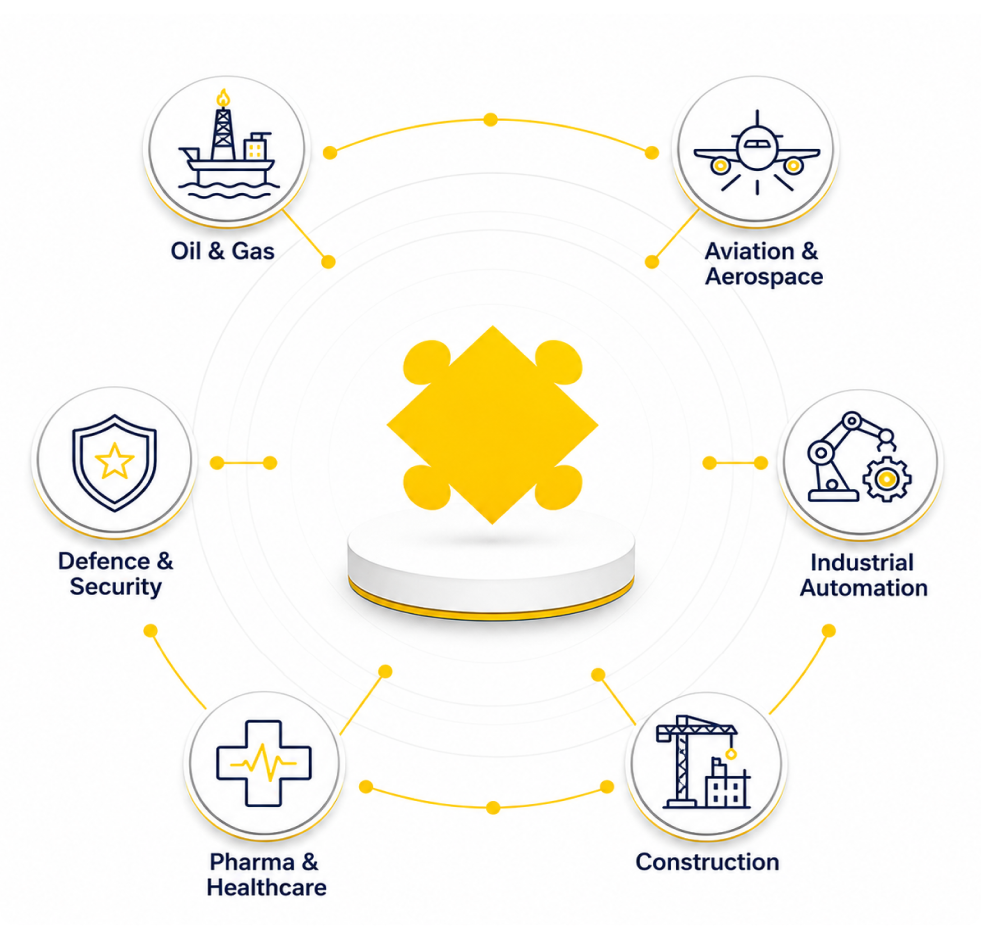
Oil & Gas

Permit-to-work, H2S awareness, emergency response, and high-risk operational safety for environments where errors have catastrophic consequences.

Aviation & Aerospace

Ground safety, FOD prevention, airside safety, and emergency evacuation for one of the world’s most safety-regulated industries.

Industrial Automation

Machine safety, LOTO procedures, manual handling, and chemical hazard training for production environments.

Construction

Site safety induction, working at height, excavation safety, and PPE compliance for project-based field environments.

Pharma & Healthcare

Cleanroom safety, biological hazard handling, patient manual handling, and fire safety for clinical and laboratory environments.

Defence & Security

Controlled procedure training and safety compliance for sensitive operational environments.

RELATED TRAINING TOPICS AND HOW CONSTELLAR BUILDS THEM

Other training topics from our Corporate Solutions range:
HOW WE BUILD IT:

Custom eLearning

The primary format for safety knowledge and awareness - custom-built for your specific hazard environment, AI-assisted in production.

ILT / VILT Development

For safety procedures requiring physical demonstration, competency sign-off, or emergency drill practice.

Frequently asked questions

Yes. Every safety training project starts with a hazard mapping exercise led by our senior instructional designers - working with your HSE team to document the specific hazards, equipment, procedures, and emergency protocols relevant to each learner group. AI-assisted tools then help us build environment-specific content efficiently; senior IDs validate every output for operational accuracy.
Safety compliance training meets a regulatory requirement - it records that a learner completed the training. Safety culture training changes how people think about and prioritise safety in their daily work. Our senior IDs design programmes that address both: meeting compliance requirements while building the understanding of why those requirements exist, which is what makes compliance sustainable.
AI-assisted tools accelerate the development of environment-specific simulation content, scenario variants, procedural demonstration video scripts, and the rapid module updates that HSE training requires when procedures or regulations change. Every AI-generated output is reviewed and validated by senior IDs for operational accuracy - in safety training, content errors are not just quality issues; they are safety risks.
We start every safety project with a hazard mapping exercise - senior IDs working with your HSE team, site managers, and front-line workers to document the specific hazards, equipment, procedures, and emergency protocols for each learner group. Every scenario, simulation, and knowledge check is then built around that specific environment.
We design safety programmes as modular systems from the outset - specific modules can be updated when procedures or regulations change without rebuilding the full programme. AI-assisted production makes these updates fast; senior IDs review every update for operational accuracy before re-deployment.

Ready to Build Safety Training That Produces a Genuine Safety Culture? Let's Talk

Tell us about your safety training challenge – we will get in touch with our honest take on the right approach for your specific operating context.