Introduction
Learning teams have consistently adapted to evolving tools, regulations, processes, and business priorities. But AI is pushing the pace beyond what traditional training cycles can handle.
In response, AI-powered course creation and authoring tools now promise one-click development from documents, videos, and recordings, with claims of five to hundred times speed gains.
The appeal is obvious. So, we tested these tools at Constellar Consulting. What we found was revealing.
Read on to see what these tools genuinely enable, where they fall short, and where human judgment remains essential.
What AI enables
Expectation: Complete, ready-to-launch courses in minutes
Reality: Faster starting points and easier change
AI tools do not deliver finished courses. Rather, they help generate initial course outlines, learning objectives, and lesson structures from source material. This reduces setup time and gives designers a draft to work with instead of a blank page. When products, policies, or processes change, related summaries, examples, assessments, and translations can be regenerated without rebuilding entire courses.
Expectation: Easy conversion of source content
Reality: Flexible formats and scalable learning
AI does not automatically make content universally relevant. What it does make easier is expressing the same learning intent across multiple formats—slides, videos, microlearning units, and scenarios—with far less production effort. This makes it easier to break large programs into smaller, reusable units that are easier to update, recommend, and maintain at scale.
Expectation: Automatic personalization of learning
Reality: Adaptive execution through interactivity and assessment
AI does not understand learners or performance needs on its own. Instead, AI-powered tools and code generators make it easier to implement adaptive elements like custom interactivities, learning paths, assessments, and feedback. The real benefit is not automation for its own sake, but the ability to keep practice and feedback aligned as content evolves.
Expectation: AI tutors replace instructors, facilitators, and coaches
Reality: Extended learning support
AI tutors do not replace human instruction. But, course-specific AI tutors, built on approved content, can provide consistent, on-demand support over time. Used carefully, they extend learning beyond formal instruction without replacing it.
The risks AI introduces in eLearning development
AI removes constraints, but it also introduces new risks that must be managed deliberately.
Data and governance risks
AI tools, without strong safeguards, can expose confidential data, intellectual property, or regulated information through reuse, leakage, or external model training. At Constellar, we work within client data protection and compliance policies, carefully defining what content can be used, how it is processed, and which tools are appropriate for the data involved.
Reliability concerns
AI output is probabilistic. It can sound confident while being incomplete or wrong. In learning contexts, this matters because inaccurate explanations shape mental models. For this reason, we treat AI-generated content as a starting point, with learning material always reviewed and validated by human experts before it reaches learners.
Instructional quality risks
AI-generated content often favors clarity and completeness over learning effectiveness. This works for awareness and knowledge sharing, but not for skill development, behavior change, or performance improvement. We mitigate this by anchoring every solution in clearly defined learning outcomes and using AI to support execution, not to decide instructional intent.
Overconfidence and sameness
Because content can be produced quickly, poor decisions can scale just as fast. Over time, learning experiences risk becoming efficient but generic without strong human direction. At Constellar, we ensure eLearning remains relevant, differentiated, and effective through intentional design choices and learning-goal-driven decisions.
Where AI-powered tools fit best
AI-powered learning tools primarily accelerate execution in:
- Transforming existing material into learning assets
- Reducing effort in production-heavy tasks (formatting, media creation, localization, updates etc.)
They do not:
- Define learning problems.
- Determine whether training is the right solution.
- Decide how learning should transfer to real work.
Those decisions require human judgment. The distinction becomes clear when learning needs are viewed side by side.
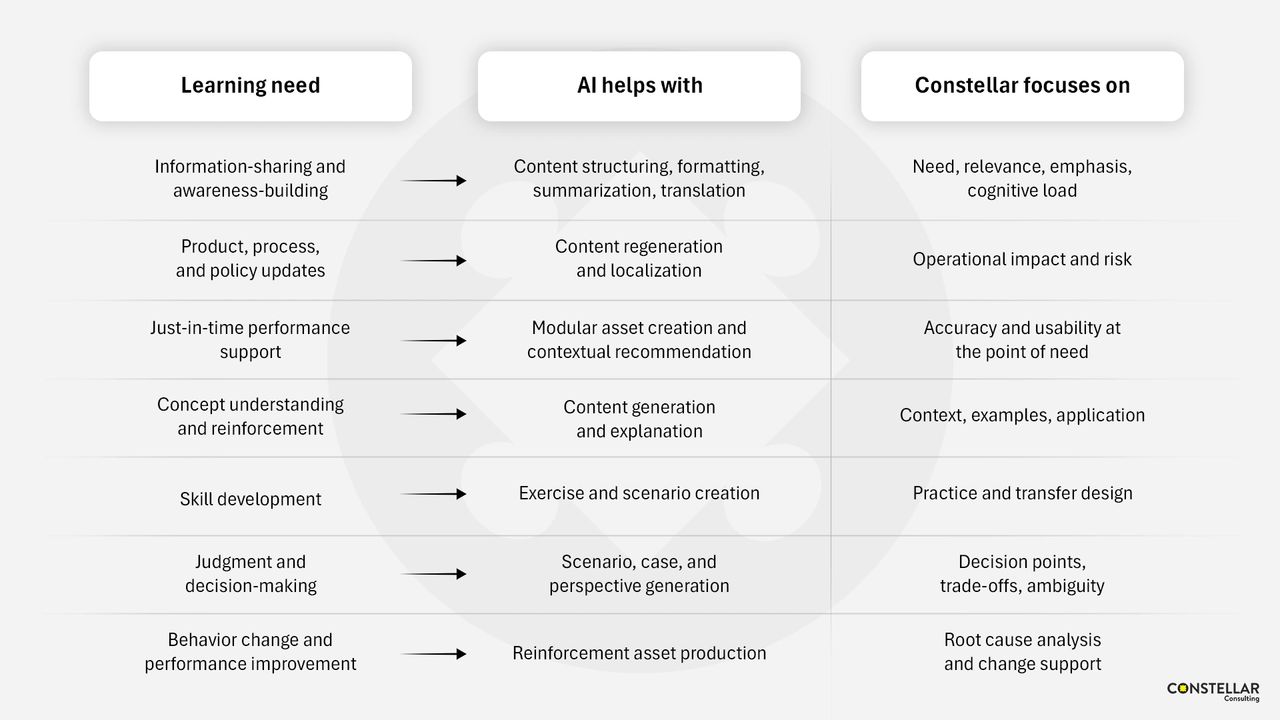
Information-sharing and awareness-building
- AI: Helps with structuring, formatting, summarizing, and translating content.
- Designers: Focus on determining need, relevance, emphasis, and cognitive load.
Product, process, and policy updates
- AI: Supports regenerating and localizing courses quickly.
- Designers: Evaluate operational impact and risk to ensure updates reflect real-world implications.
Just-in-time performance support
- AI: Enables the creation of modular assets, micro-content, and contextual recommendations.
- Designers: Ensure accuracy and usability at the point of need.
Concept understanding and reinforcement
- AI: Assists with content production, updating examples, and generating variations.
- Designers: Provide context, select meaningful examples, and guide application.
Skill development
- AI: Helps draft exercises and scenarios.
- Designers: Design practice and support learning transfer to real situations.
Judgment and decision-making
- AI: Helps generate scenarios, cases, studies, and alternative viewpoints.
- Designers: Frame trade-offs and manage ambiguity.
Behavior change and performance improvement
- AI: Helps produce reinforcement assets at scale.
- Designers: Diagnose root causes and support sustained behavior change.
Closing reflection
AI has reduced much of the invisible labor that once dominated eLearning development. What remains is the work that determines learning quality: judgment, context, intent, and meaning.
This is how Constellar approaches AI in eLearning development: using efficiency to create space for better thinking, not simply more output.
How can you benefit from this improvement in your organization? Let’s talk.